
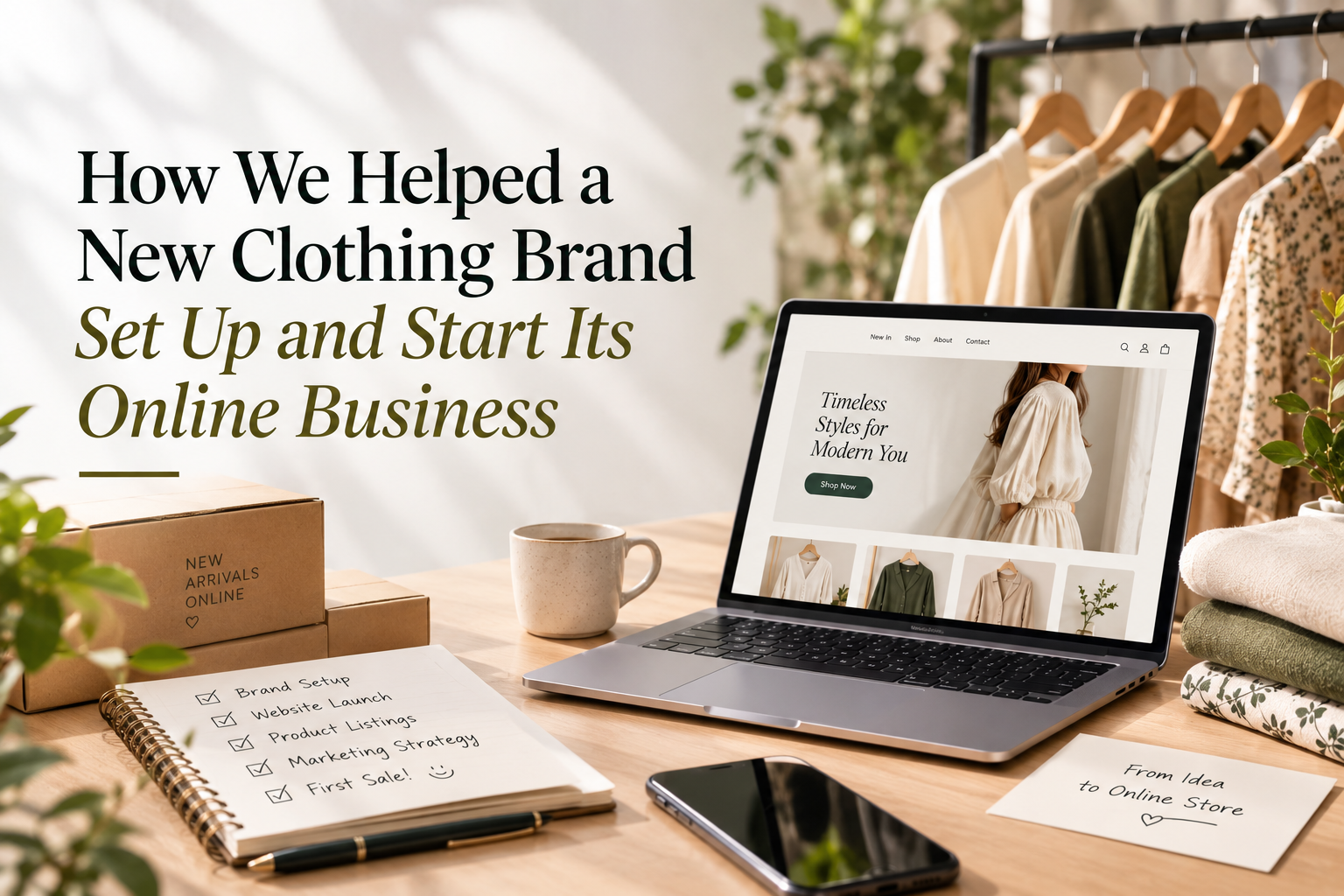
Starting a clothing brand is one thing. Building a clothing brand that is ready to sell online is another.
A new clothing brand may have great products, attractive designs and a clear vision, but that alone doesn’t create an online business.
You need a website that converts visitors into customers. You need the right product photography. You need social media content that communicates the brand. You need a reliable courier partner, customer support, payment and order processes, performance marketing, SEO and retention marketing.
This is exactly where we helped a new clothing brand.
Instead of looking at individual activities separately, we worked on the complete online setup — from the website and ecommerce shoot to marketing, customer care and customer retention.
The objective was simple:
Build the foundation required for the brand to start selling online and create a system that could grow with the business.
How We Helped Set Up the New Clothing Brand Online
1. Understanding the Brand and Its Products
Before starting the website or marketing, we first needed to understand the brand.
We looked at:
- Product categories
- Target customers
- Price points
- Brand positioning
- Product quality
- Competitors
- Customer profile
- Product margins
- Expected average order value
- Potential selling markets
- Brand personality
This helped us decide how the brand should look and communicate online.
A clothing brand’s website, social media, advertising and content should not feel like four different businesses.
Everything needs to communicate the same brand.
2. Creating the Ecommerce Website
The first major step was creating the brand’s online store.
The website needed to do more than display products.
It needed to help a new customer understand the brand, explore products, trust the business and complete a purchase easily.
We worked on the overall ecommerce website structure, including:
- Homepage
- Product pages
- Collection/category pages
- Product descriptions
- Product images
- Size information
- Shipping information
- Return and exchange information
- Contact information
- About the brand
- Checkout journey
- Payment options
- Mobile experience
For a new clothing brand, the product page is particularly important.
A customer cannot physically touch or try the product before buying it.
The website therefore needs to answer as many questions as possible:
How does it look?
What is the fabric?
What is the fit?
Which size should I choose?
When will it arrive?
Can I exchange it?
Is COD available?
The easier we make these decisions, the easier it becomes for a customer to purchase.
3. Planning the Ecommerce Product Shoot
One of the most important things we helped the brand with was the ecommerce shoot.
A common mistake new clothing brands make is treating a photoshoot as simply:
“Let’s get some nice pictures.”
For an online clothing business, the shoot has a much bigger purpose.
The images need to work across:
- Website
- Meta Ads
- Google Ads
- Product catalogues
- Promotional campaigns
- Social media content
So before the shoot, we helped define what type of images and videos were required.
4. Giving Ideas for the Product Shoot
We suggested different types of shots instead of relying on one standard photograph per product.
For example:
Product-focused shots
Clean images that clearly show the clothing.
Model shots
To help customers understand how the product looks when worn.
Front and back shots
To show the overall design.
Close-up shots
To highlight fabric, embroidery, texture, prints and finishing.
Detail shots
Useful for communicating product quality.
Lifestyle shots
To show how and where the product can be worn.
Short-form videos
Useful for Reels, Meta Ads and other digital campaigns.
The idea was to create content that could be reused across the entire digital ecosystem.
One good shoot should give a brand content for more than just its website.
5. Creating a Social Media Strategy
Once the website and product content were being developed, we worked on the social media direction.
For a new clothing brand, social media shouldn’t simply become a place where every post says:
“Buy this product.”
People need to understand the brand first.
The strategy can include a combination of:
- Product content
- Styling ideas
- New arrivals
- Product details
- Behind-the-scenes content
- Fashion inspiration
- Educational content
- Customer content
- Testimonials
- Founder/brand stories
- Offers
- Seasonal campaigns
- Reels
- Stories
The objective is to build a social presence that makes the brand look active, trustworthy and relevant.
6. Setting Up the Courier and Shipping Process
Getting an order is only one part of ecommerce.
The brand also needs to deliver that order successfully.
We helped the brand work through the courier and shipping setup, including:
- Courier partner selection
- Shipping process
- Order processing
- Tracking
- COD shipments
- Delivery updates
- Returns
- Exchanges
- RTO handling
This is particularly important for a new Indian D2C clothing brand.
A poor delivery experience can affect:
- Customer satisfaction
- Reviews
- Repeat purchases
- Cash flow
- Marketing profitability
So logistics needs to be considered from the beginning.
7. Setting Up Customer Care
A new online clothing brand will receive questions every day.
Customers may ask:
“Which size should I order?”
“When will my order arrive?”
“Can I change my address?”
“Is COD available?”
“Can I exchange the size?”
“How do I track my order?”
Customer care therefore becomes an important part of the ecommerce experience.
We helped establish the customer communication process so customers could receive support before and after placing an order.
The objective was not simply to answer messages.
It was to make customer support part of the sales and retention process.
8. Setting Up Performance Marketing
Once the website, products, creatives and basic operations were ready, the next step was customer acquisition.
This is where performance marketing came in.
We worked on paid marketing across platforms such as:
- Meta Ads
- Google Ads
- Product-focused campaigns
- Retargeting
- Catalogue campaigns
- Search campaigns
- Shopping campaigns
But performance marketing isn’t simply:
“Put money into Meta and wait for sales.”
We needed to understand:
- Which products should be promoted?
- Which creatives should be tested?
- Which audiences should be targeted?
- What should the landing page communicate?
- What is the average order value?
- What is the acceptable customer acquisition cost?
- Which products generate repeat purchases?
- Where are customers dropping from the funnel?
This allowed marketing decisions to be connected with the actual ecommerce business.
9. Building the Creative Strategy for Performance Marketing
The same product can be advertised in several different ways.
For example, a clothing product could be presented through:
- Product-focused creative
- Model creative
- Styling idea
- Price/offer creative
- Product benefit
- Fabric/detail angle
- UGC-style video
- Customer testimonial
- Collection creative
- Seasonal campaign
We helped the brand think beyond simply boosting Instagram posts.
The objective was to create different creative angles that could be tested through performance marketing.
Because when one creative stops working, the brand needs another idea ready.
10. Setting Up SEO
Paid advertising can bring customers quickly, but a brand should also work on organic visibility.
We worked on the SEO foundation for the ecommerce website.
This included areas such as:
- Product page SEO
- Collection/category SEO
- Website structure
- Search-friendly product content
- Internal linking
- Metadata
- Image optimisation
- Search Console
- Technical SEO
- Content opportunities
The objective was to help the brand become discoverable when potential customers search for relevant products and categories.
SEO is not about filling pages with keywords.
It is about making the website useful and understandable for both customers and search engines.
11. Setting Up Retention Marketing
Getting the first customer is expensive and important.
Keeping that customer can become even more valuable over time.
That’s why we also considered retention marketing.
Depending on the brand and customer journey, this can include:
- WhatsApp marketing
- Email marketing
- New arrival communication
- Back-in-stock alerts
- Abandoned cart communication
- Post-purchase communication
- Repeat purchase campaigns
- Product recommendations
- Customer segmentation
- Festival campaigns
- Special customer offers
The objective is to avoid treating every customer as a one-time transaction.
A customer who has already purchased from the brand has already crossed one of the biggest barriers: trust.
The next opportunity is to give them a reason to come back.
12. Connecting Everything Together
This was the most important part of the project.
Website development, photography, social media, courier, customer care, performance marketing, SEO and retention cannot operate independently.
They influence each other.
For example:
Better photography → better creatives
Better creatives → better advertising
Better website → better conversion
Better customer experience → fewer complaints
Better delivery → better customer satisfaction
Better retention → more repeat purchases
Better data → better marketing decisions
This is why we approached the brand as an online business, not simply as a website project or advertising project.
13. What a New Clothing Brand Actually Needs to Start Selling Online
If you’re launching a clothing brand today, the checklist goes far beyond Instagram and a Shopify website.
You need to think about:
Brand
- Positioning
- Target customer
- Pricing
- Product assortment
- Brand communication
Website
- Ecommerce store
- Product pages
- Mobile experience
- Checkout
- Payment gateway
- Policies
Content
- Product photography
- Model shoot
- Videos
- Reels
- Social media creatives
Operations
- Inventory
- Order processing
- Courier
- Shipping
- COD
- Returns
- Exchanges
- RTO
Customer Experience
- Customer care
- Order updates
- Post-purchase communication
Marketing
- Meta Ads
- Google Ads
- SEO
- Social media
- Retargeting
Retention
- Repeat purchase
- Abandoned cart
- Customer segmentation
Analytics
- Ecommerce tracking
- Conversion tracking
- Revenue reporting
- Marketing performance
- Customer acquisition cost
- AOV
- Repeat purchase data
When these pieces work together, you don’t just have a clothing website.
You have an online business.
14. The Biggest Lesson From Setting Up a New Clothing Brand Online
One of the biggest lessons from this project was simple:
Launching an ecommerce brand is not one task. It is a chain of connected tasks.
A founder might think:
“I have products. I just need a website and Instagram.”
But the real journey looks more like:
Product → Brand → Photography → Website → Social Media → Payment → Courier → Customer Care → Performance Marketing → SEO → Retention → Repeat Customers
If one part is weak, it can affect the rest of the business.
That’s why we worked across the complete digital journey instead of treating each requirement as a separate service.
15. How Growthora Helps New Clothing and D2C Brands
At Growthora, we work with brands that want to build and grow their online business.
Our work can cover the complete digital growth journey, including:
- Ecommerce website setup
- Shopify and D2C website support
- Product shoot planning
- Ecommerce creative strategy
- Social media strategy
- Meta Ads
- Google Ads
- Performance marketing
- SEO
- Customer care processes
- Courier and shipping setup
- WhatsApp marketing
- Email marketing
- Retention marketing
- Ecommerce analytics
- Conversion optimisation
The exact requirement is different for every brand.
Some brands need help launching their online store.
Some already have a website but aren’t getting enough sales.
Some have sales but struggle with profitability.
Others need help with advertising, retention or scaling.
The first step is understanding where the business currently stands and what needs to be built next.
Starting a Clothing Brand Online?
If you are launching a new clothing brand and want to build the complete online setup — from website and ecommerce shoot to social media, courier, customer care, performance marketing, SEO and retention — Growthora can help you put those pieces together.
Because the goal isn’t just to launch a website.
The goal is to build a clothing brand that is ready to sell, serve and grow online.